Parasite pressure in Middle Tennessee stems directly from humid climatic conditions, dense hardwood canopy, and urban wildlife corridors that run adjacent to residential lawns. Nashville properties near overgrown…
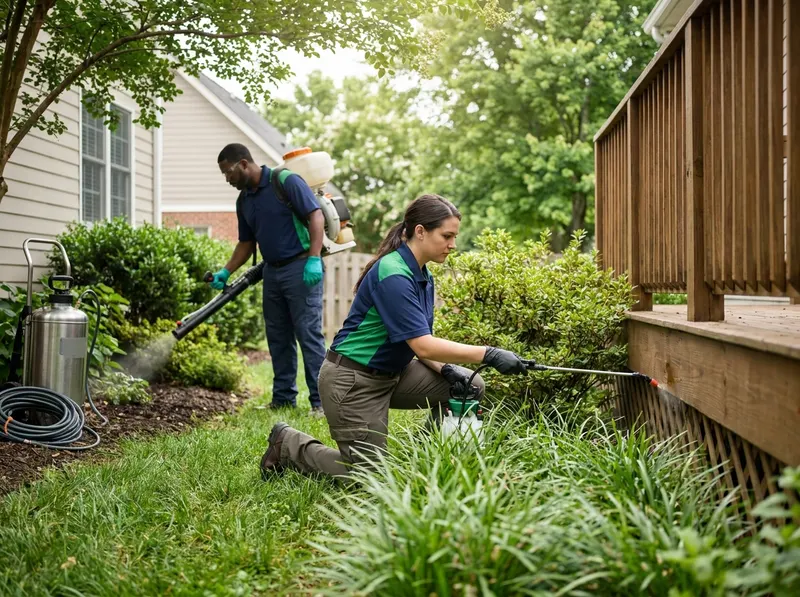
Parasite pressure in Middle Tennessee stems directly from humid climatic conditions, dense hardwood canopy, and urban wildlife corridors that run adjacent to residential lawns. Nashville properties near overgrown greenways or wooded lot lines, such as parcels bordering Shelby Bottoms Greenway in East Nashville or wooded perimeters near Radnor Lake State Natural Area in Crieve Hall, face intense pressure from mammalian vectors. The white-tailed deer and urban opossum frequently deposit early instars of the lone star tick and blacklegged tick into turf canopies. Fleas thrive equally well in shaded, moisture-rich clay soils found in historic neighborhoods like Germantown, Belmont-Hillsboro, and Inglewood. MapleDrift Extermination addresses these threats by mapping structural exposure and targeting exterior resting harborage rather than applying non-specific blanket broadcasts.
Outdoor management relies on establishing multi-tiered liquid barriers along structural foundations, shaded fence lines, and low-hanging decorative foliage using active ingredients recognized by the US Environmental Protection Agency. Technicians apply specialized insect growth regulators (IGRs) that interrupt chitin synthesis, arresting the development of flea pupae and preventing tick larvae from reaching reproductive adulthood, adhering strictly to standards from the Entomological Society of America. Rather than requiring mandatory annual subscription commitments, protocols are customized to the property footprint. Granular barrier applications cover turf transitions out to 30 feet from living spaces, while liquid treatments target leaf litter zones where domestic pets encounter questing ticks. This approach reduces unnecessary pesticide runoff into local stormwater basins regulated by the Tennessee Department of Environment and Conservation.
Indoor remediation procedures deploy low-odor, targeted microencapsulated formulations applied directly to floorboards, carpet base matrices, and resting areas beneath elevated furniture. Before human and animal occupants return, interior applications dry completely over a mandatory 2-to-4-hour evacuation window, satisfying safety parameters tracked by the Centers for Disease Control and Prevention and the Association of American Pesticide Control Officials. For properties featuring crawl spaces or raised pier foundations in The Nations, Sylvan Park, or Donelson, technicians conduct moisture assessments alongside digital entry-point mapping to eliminate damp conditions that shelter stray rodent hosts. These methods comply with professional application guidance established by the National Pest Management Association and integrated pest management principles outlined by the USDA Natural Resources Conservation Service.
Long-term control hinges on addressing physical yard layout. Maintaining clipped lawn borders, thinning damp wood piles, and elevating ground-contact firewood stacks reduce environmental carrying capacity for both ectoparasites and their reservoir hosts. MapleDrift Extermination pairs this structural barrier defense with transparent documentation, offering Nashville homeowners clear evidence of targeted eradication without recurring billing pressure.
Every job gets a firm, written price after a free on-site visit.
Tell us about your fleas & ticks environmental management job in Nashville and we'll send a clear, written quote, usually the same day.
 MapleDrift Extermination