Crawl space pest barrier management addresses the primary vulnerability of Southeastern residential architecture: unconditioned, vented dirt subfloors exposed to elevated relative humidity and native clay soils.…
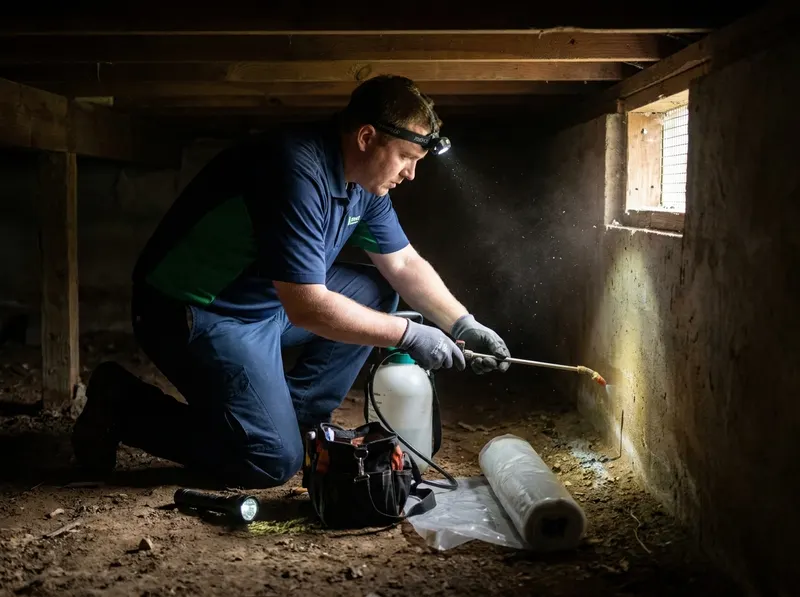
Crawl space pest barrier management addresses the primary vulnerability of Southeastern residential architecture: unconditioned, vented dirt subfloors exposed to elevated relative humidity and native clay soils. According to guidance from the EPA on integrated pest management, structural exclusion delivers superior long-term results compared to repetitive chemical broadcasts. In older raised-foundation homes across East Nashville and Germantown, legacy brick-and-mortar piers frequently develop hairline fissures that grant entry to German roaches, field mice, and subterranean termites. Installing a continuous, sealed 12-mil poly barrier over exposed dirt cuts ambient foundation moisture below the 50% relative humidity threshold defined by the Building Science Corporation, starving moisture-dependent pests like camel crickets of their required habitat. The trade-off between open vented systems and closed barriers centers on upfront installation investment versus ongoing subfloor lumber maintenance, because unmitigated crawl space dampness routinely triggers wood decay alongside termite colonization.
Subterranean termite pressures run exceptionally high across Middle Tennessee due to dense limestone bedrock and moist topsoils near waterways like the Cumberland River and Mill Creek. The Tennessee Department of Agriculture Pesticide Division regulates termiticides to safeguard regional water tables, making targeted non-repellent soil barriers along crawl space stem walls essential. In neighborhoods such as Belmont-Hillsboro, Sylvan Park, and The Nations, pier-and-beam properties require precision masonry drilling and sill-plate treatments using borate salt solutions, which conform to standards established by the American Wood Protection Association. Borate mineral salts penetrate framing lumber to crystallize inside cellulose fibers, preventing colonization by powderpost beetles without off-gassing volatile compounds into the living spaces overhead, which supports domestic health standards recognized by the Centers for Disease Control and Prevention.
Rodent exclusion requires mechanical durability that standard plastic liners cannot provide alone. Field mice and Norway rats frequently gnaw through unreinforced materials; thus, MapleDrift Extermination secures subfloor perimeters using 1/4-inch galvanized hardware cloth over crawl space foundation vents, matching structural standards published by the U.S. Department of Housing and Urban Development. In forested drainage areas adjacent to Percy Warner Park, Radnor Lake State Natural Area, and Donelson, expansive crawl spaces also need rigid closure around plumbing drops and electrical chases. Technicians seal these penetrations with copper wire mesh and elastomeric polyurethane sealants that meet ASTM E84 fire-spread standards. Proper mechanical detailing preserves subfloor access for trade professionals while satisfying residential drainage and safety requirements outlined by the Occupational Safety and Health Administration.
Technicians follow an objective, four-step structural implementation sequence: 1. Complete sub-floor digital mapping to catalog every foundation breach, plumbing penetration, and termite mud tube across all foundation walls; 2. Removal of organic ground debris and contaminated insulation to eliminate active shelter sources; 3. Installation of puncture-resistant soil barriers mechanically pinned to masonry walls with closed penetrations, referencing energy and moisture guidance from the U.S. Department of Energy; 4. Establishing a continuous interior stem-wall termiticide boundary using chemistries evaluated by the National Pesticide Information Center. This mechanical-first protocol resolves active infestations without recurring broadcast sprays, returning structural stability and domestic comfort to residences in Crieve Hall, Inglewood, and Green Hills.
Every job gets a firm, written price after a free on-site visit.
Tell us about your crawl space pest barrier management job in Nashville and we'll send a clear, written quote, usually the same day.
 MapleDrift Extermination